The Invisible World: Ghost Hunting Reveals Unseen Conflicts
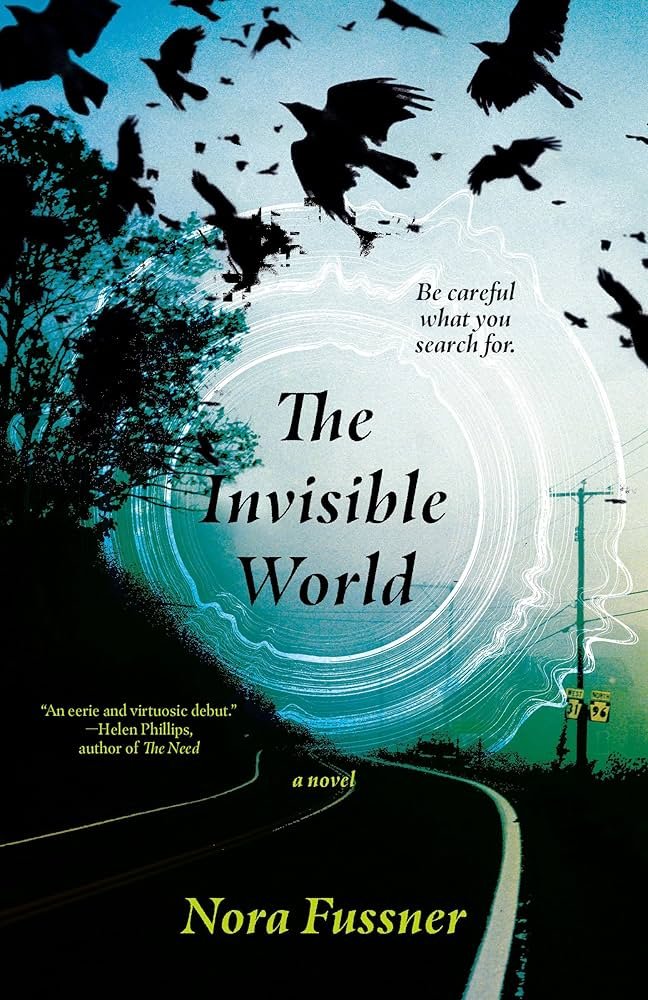
The Invisible World
Nora Fussner
Paranormal Fiction
Vintage
2023
I picked up The Invisible World knowing only that it was a debut novel playing with point of view, paranormal elements, and the friction between corporate ambition and human need—three things I am perpetually hungry for. (Truly, everyone should write more spooky books about living and dying inside systems; please and thank you.) My early hope was that this might be The Haunting of Hill House filtered through the machinery of reality television, with the network need to streamline and sensationalize adding yet another layer of competing desires to an already volatile mix.
The Plot
The Invisible World brings together two groups with very different goals. There’s the struggling production crew of a paranormal TV spinoff, Searching for the Invisible World, and a trio of earnest local ghost hunters known as the Paranormal Investigators of Pennsylvania (PIP). Both descend on the home of a young couple, where personal ambition, buried secrets, and genuinely inexplicable phenomena begin to collide. It doesn’t take long for the story to suggest that the living inhabitants may be more haunting—and more dangerous—than any ghost.
The novel moves fluidly between the perspectives of several impressively realized characters, but its emotional center rests with Sandra, the show’s assistant producer, and Eve, one of the homeowners. Their interior lives anchor the book. Through them, the paranormal elements stay tethered to recognizable human longing rather than drifting into spectacle.
Structurally, Fussner employs a mixed-media approach. Traditional prose is interwoven with promotional teasers for the episode being filmed, along with transcripts of the “raw” footage captured by the crew. The shift into transcript form offers a compelling peek behind the curtain. The material is unprocessed, and it subtly turns the reader into an editor, tracking what might be reframed, cut, or quietly erased in the final version. It also evokes the feeling of an evidence dossier—something people will need to return to, again and again, once it becomes clear that a single catastrophic moment has shattered the illusion of control.
This is not a ghost story in the conventional sense, despite the book’s marketing copy, the diegetic TV production, and at times even the prose itself teasing a paranormal thriller. What the story ultimately delivers is something quieter. The ghosts serve as catalysts rather than antagonists, revealing the emotional “invisible world” each character carries with them. The climax hinges on self-recognition rather than supernatural bombast. I found this choice thoughtful and thematically coherent, even when it diverged sharply from what I initially expected.
The Characters
The character work here is, quite simply, a triumph.
Fussner… [allows] their contradictions to stand without flattening them into easily marketable archetypes.
Sandra and Eve feel like real women struggling to define and accept themselves. Fussner writes them with nuance and clear respect for intersectionality, allowing their contradictions to stand without flattening them into easily marketable archetypes. Reality television becomes a particularly sharp foil for these characters, both of whom resist being reduced to a single narrative trope, even when doing so might offer safety, approval, or professional gain.
The supporting cast is equally engaging. The people who orbit Sandra and Eve—often men who support and undermine them simultaneously—are written with clear motivations and enough depth to invite speculation about the complicated lives they led before the events of the novel. Even when characters behave badly, their actions feel rooted in pressure rather than convenience.
Unpredictable and occasionally dangerous paranormal entities do appear. Still, the role of primary antagonist is fittingly dispersed. The true threats are systemic. Social pressure to conform within a family, a small town, or a marketing demographic. A content-creation machine that prizes spectacle over truth and profit over people. A society that denies or pathologizes experiences it cannot easily explain. In this sense, the horror at the heart of The Invisible World feels uncomfortably familiar.
A Note on the Audiobook
The audiobook adaptation emphasizes the novel’s dual presentation styles by assigning a single narrator, Samantha Desz, to the prose sections, while the transcript portions are performed by a full cast. On paper, this sounds like a clever solution. In practice, I found it deeply frustrating.
This is a story that would benefit enormously from a full-cast production throughout. With multiple factions—the homeowners, PIP, and the Searching for the Invisible World crew—and a large ensemble of characters with similar demographic markers (a dozen or so generic white people with generic white people names), clarity becomes essential. That’s a tall order for a single narrator. Even with dialogue tags and descriptive cues, I frequently lost track of who was present in a scene or who was speaking. More than once, a revelation landed and I had to pause—or backtrack entirely—just to determine whom it was happening to.
A fully cast production—or a more listener-conscious edit—would have made a significant difference.
Ironically, the transcript sections proved even harder to follow. In text, each line is clearly attributed:
TODD: Didn’t you see something? MARY: No, I really didn’t.
In the audiobook, those speaker tags are omitted in favor of a more naturalistic performance. That choice makes sense in theory. In reality, the listener has no time to acclimate to the actors’ voices, since they appear only in these sections. The result is a chorus of unfamiliar, unattributed dialogue. Strangely, I found it easier to picture characters who were speaking off-camera—since the narrator occasionally names them—than those ostensibly present in the scene.
I ultimately had to stop the audiobook about halfway through. Simply keeping track of who was speaking gave me a genuine headache. This is a real shame. The performers are clearly talented, and the text itself has the potential to be an excellent listening experience. A fully cast production—or a more listener-conscious edit—would have made a significant difference.
Who Would Enjoy This?
If you enjoy stories that sit in the uneasy space between the “normal” and the paranormal, The Invisible World is likely to work for you. Readers who gravitate toward ensemble casts—where characters feel like people rather than plot devices—will appreciate the care Fussner takes in rendering even minor figures with recognizable motivations and interior lives. The novel also rewards those who enjoy secrets, scandals, and characters who make ethically compromised choices for reasons that feel understandable, if not always defensible. Finally, this is a book for readers comfortable closing the final page with lingering questions rather than tidy explanations.
Readers who need airtight lore, definitive answers, or neatly resolved mysteries may find the experience frustrating. For those willing to sit with ambiguity—and to recognize that the most restless spirits are often still alive—The Invisible World offers a thoughtful, unsettling, and emotionally rich read.



Leave a Reply