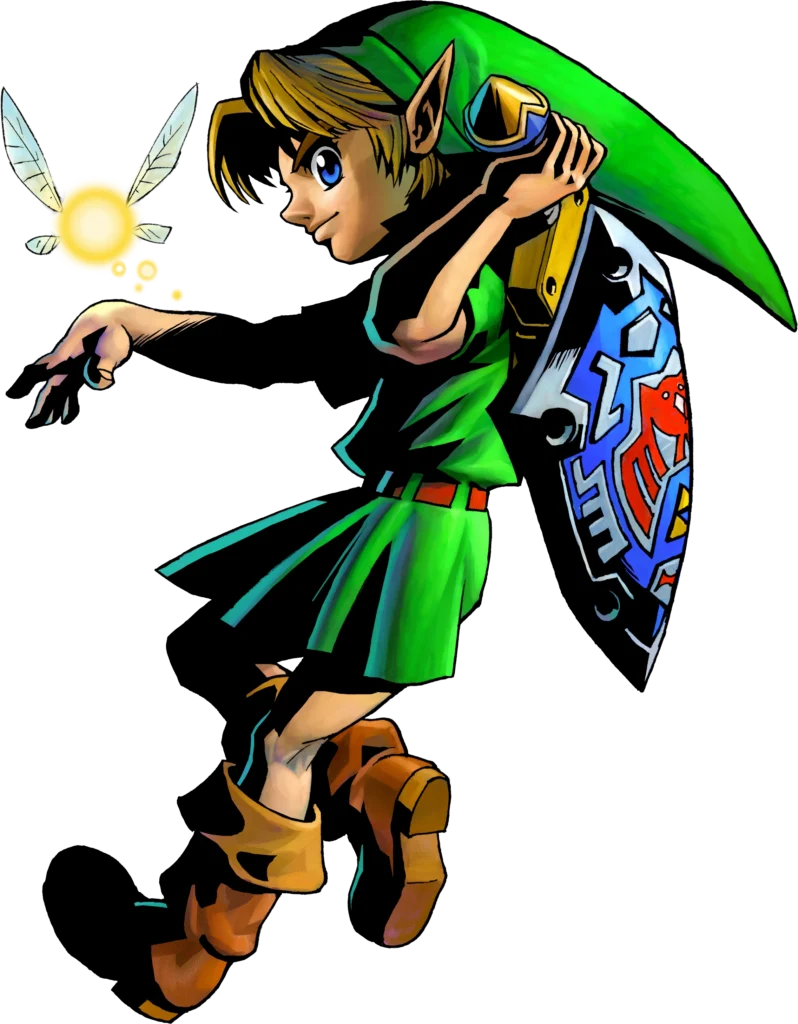
Winter, 1999. While the rest of the world fretted about the impending chaos of the Y2K bug, I had far more pressing concerns. Namely: the impressively moody marketing for The Legend of Zelda: Majora’s Mask .
My strict parents had a history of quietly vetoing Christmas wish list items they found too dark, too violent, or too weird. Majora’s Mask looked like it might check all three boxes. What if the unsettling imagery spooked them enough to strike it from the list?
“Unsettling.” -My parents in 1999, apparently The premise alone had me hooked. Series hero Link had an entire world to save—but only three days to do it. When the clock runs out, time resets and he starts again. Fortunately, he has his standard fantasy toolkit plus a strange new ability: he can assume the identities of three other people, each with their own relationships, abilities, and perspectives. Without those borrowed lives, there’s no way he can prevent catastrophe.
Unlike many childhood ad campaigns that captured my imagination and then disappointed, Majora’s Mask undersold itself. Nearly thirty years later, I still revisit the game just to sink back into that eerie 72-hour loop.
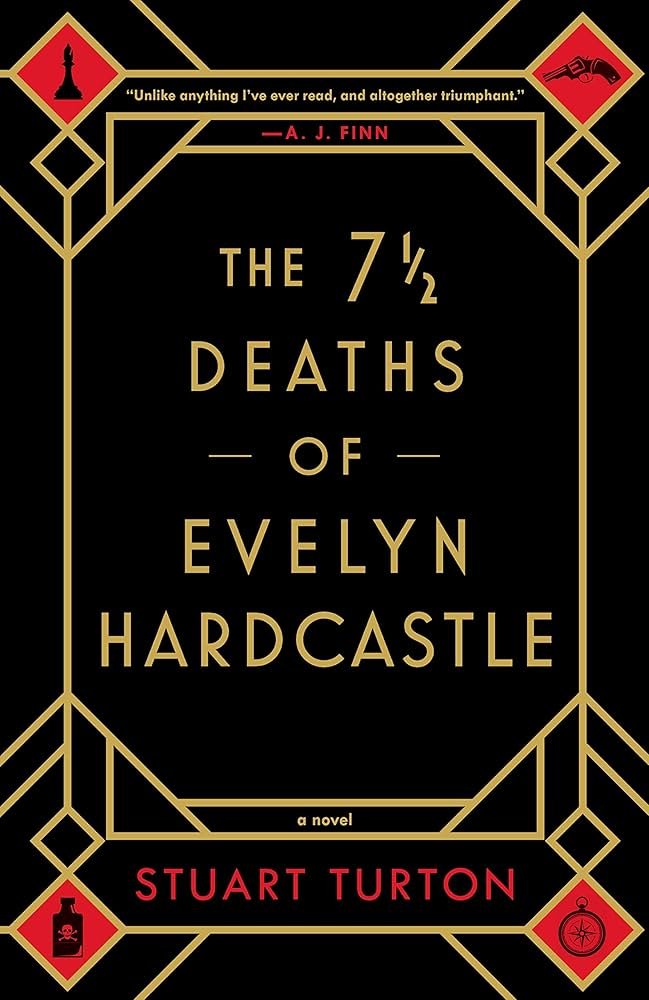
Which raises an obvious question: with my love of identity-swapping, time loops, and a good mystery, why did it take me seven and a half years to discover The 7½ Deaths of Evelyn Hardcastle?
The Plot
To avoid spoilers, I’ll stick to the information already found in the book’s own marketing.
Aiden Bishop must escape Blackheath Manor, a crumbling estate whose secrets are as unsteady as its architecture. There’s only one way out: solve a murder before it happens.
Simple? Not even close.
Every midnight, time resets. Aiden wakes up reliving the same day—but inside the body of a different guest attending the manor’s decadent house party. Each evening, during a grand masque ball, Evelyn Hardcastle dies beside the reflecting pool. If Aiden can identify the killer before he runs out of time—and bodies—he’ll finally escape the loop.
Like Majora’s Mask , the story plays gleefully with identity and repetition. Each new “run” through the day reveals different clues, relationships, and consequences. The familiar gradually becomes strange, and the strange becomes essential.
And just like in that old game cartridge from 1999, the clock never stops ticking.
The Characters
“How lost do you have to be to let the devil lead you home?”
The plot of Evelyn Hardcastle is fiendishly clever, and its setting—a secret-laden aristocratic gathering somewhere in the 1920s—is cinematic from the first page. But the book’s real triumph is its characters.
Aiden doesn’t simply borrow bodies. Each “host” brings their own strengths, weaknesses, and ways of thinking. Age, physical ability, social standing, trauma, even a period-appropriate exploration of neurodivergence all shape how Aiden experiences the world. Some hosts move through the manor with grace and authority. Others struggle with fear, pain, or prejudice.
No two perspectives feel the same—not to Aiden, and not to the reader.
Despite the gloomy setting and the generally miserable outlook of Blackheath’s inhabitants, the novel carries an undercurrent of sly humor. Aiden’s narration is observant and self-aware, and the hosts themselves—often at their most ridiculous or worst—create moments that sparkle against the dark backdrop.
One of my favorite lines arrives early in the novel. Newly awake and amnesiac, Aiden must choose between wandering an unfamiliar forest alone or following a stranger who has just murdered someone in front of him:
“How lost do you have to be to let the devil lead you home?
It perfectly captures the book’s tone: dark, absurd, and irresistibly curious about the human condition.
A Note on the Audiobook
The audiobook version, narrated by James Cameron Stewart, adds another layer of fun to an already intricate story. Stewart deploys an impressive range of character voices and sharp comedic timing to navigate the novel’s many tonal shifts.
At first, his delivery struck me as unusually dry. But before long I realized it fits Aiden perfectly. Faced with a surreal loop of murder, deception, and identity theft, Aiden’s understated tone feels less like indifference and more like survival. Deadpan becomes a coping mechanism.
Once that clicked, the performance became the perfect companion to the story’s twisting structure.
Who Would Enjoy This?
Readers who love:
Flashy historical settings
Memorable, complicated characters
Carefully engineered mysteries
Stories that blend speculative ideas with emotional realism
This novel sits at a fascinating intersection: part historical puzzle box, part speculative thriller, and part character study. If someone ever makes the video-game version, I’ll happily lose several weekends to it.
The special “7½ Anniversary Edition ” is already sitting on my wish list, a fitting echo to my time-travel-centric childhood dreams.
And much like those long nights revisiting The Legend of Zelda: Majora’s Mask , the moment I finished the book for the first time, I immediately flipped back to the beginning. It’s a loop I never regret getting stuck in.
Where To Find This Book
[{"id":258,"link":"https:\/\/books.stylemymoney.com\/the-7-%c2%bd-deaths-of-evelyn-hardcastle-a-mystery-worth-repeating\/","name":"the-7-%c2%bd-deaths-of-evelyn-hardcastle-a-mystery-worth-repeating","thumbnail":{"url":"https:\/\/books.stylemymoney.com\/wp-content\/uploads\/2026\/03\/Evelyn-Hardcastle.png","alt":""},"title":"The 7 \u00bd Deaths of Evelyn Hardcastle: A Mystery Worth Repeating","author":{"name":"christyogawa@gmail.com","link":"https:\/\/books.stylemymoney.com\/author\/christyogawagmail-com\/"},"date":"Mar 15, 2026","dateGMT":"2026-03-15 01:05:09","modifiedDate":"2026-03-15 01:09:41","modifiedDateGMT":"2026-03-15 01:09:41","commentCount":"0","commentStatus":"open","categories":{"coma":"<a href=\"https:\/\/books.stylemymoney.com\/category\/4-stars\/\" rel=\"category tag\">4+ Stars<\/a>, <a href=\"https:\/\/books.stylemymoney.com\/category\/book-review\/\" rel=\"category tag\">Book Review<\/a>, <a href=\"https:\/\/books.stylemymoney.com\/category\/locked-room-mystery\/\" rel=\"category tag\">Locked Room Mystery<\/a>, <a href=\"https:\/\/books.stylemymoney.com\/category\/murder-mystery\/\" rel=\"category tag\">Murder Mystery<\/a>, <a href=\"https:\/\/books.stylemymoney.com\/category\/psychological\/\" rel=\"category tag\">Psychological<\/a>, <a href=\"https:\/\/books.stylemymoney.com\/category\/stuart-turton\/\" rel=\"category tag\">Stuart Turton<\/a>, <a href=\"https:\/\/books.stylemymoney.com\/category\/thriller\/\" rel=\"category tag\">Thriller<\/a>, <a href=\"https:\/\/books.stylemymoney.com\/category\/time-travel\/\" rel=\"category tag\">Time Travel<\/a>","space":"<a href=\"https:\/\/books.stylemymoney.com\/category\/4-stars\/\" rel=\"category tag\">4+ Stars<\/a> <a href=\"https:\/\/books.stylemymoney.com\/category\/book-review\/\" rel=\"category tag\">Book Review<\/a> <a href=\"https:\/\/books.stylemymoney.com\/category\/locked-room-mystery\/\" rel=\"category tag\">Locked Room Mystery<\/a> <a href=\"https:\/\/books.stylemymoney.com\/category\/murder-mystery\/\" rel=\"category tag\">Murder Mystery<\/a> <a href=\"https:\/\/books.stylemymoney.com\/category\/psychological\/\" rel=\"category tag\">Psychological<\/a> <a href=\"https:\/\/books.stylemymoney.com\/category\/stuart-turton\/\" rel=\"category tag\">Stuart Turton<\/a> <a href=\"https:\/\/books.stylemymoney.com\/category\/thriller\/\" rel=\"category tag\">Thriller<\/a> <a href=\"https:\/\/books.stylemymoney.com\/category\/time-travel\/\" rel=\"category tag\">Time Travel<\/a>"},"taxonomies":{"post_tag":"<a href='https:\/\/books.stylemymoney.com\/tag\/1920s-setting\/' rel='post_tag'>1920s setting<\/a><a href='https:\/\/books.stylemymoney.com\/tag\/atmospheric-fiction\/' rel='post_tag'>atmospheric fiction<\/a><a href='https:\/\/books.stylemymoney.com\/tag\/audiobook-review\/' rel='post_tag'>audiobook review<\/a><a href='https:\/\/books.stylemymoney.com\/tag\/blackheath-manor\/' rel='post_tag'>Blackheath Manor<\/a><a href='https:\/\/books.stylemymoney.com\/tag\/body-swapping\/' rel='post_tag'>body swapping<\/a><a href='https:\/\/books.stylemymoney.com\/tag\/book-recommendations\/' rel='post_tag'>book recommendations<\/a><a href='https:\/\/books.stylemymoney.com\/tag\/book-review\/' rel='post_tag'>book review<\/a><a href='https:\/\/books.stylemymoney.com\/tag\/genre-bending-fiction\/' rel='post_tag'>genre-bending fiction<\/a><a href='https:\/\/books.stylemymoney.com\/tag\/historical-fiction\/' rel='post_tag'>historical fiction<\/a><a href='https:\/\/books.stylemymoney.com\/tag\/historical-mystery\/' rel='post_tag'>historical mystery<\/a><a href='https:\/\/books.stylemymoney.com\/tag\/identity-and-memory\/' rel='post_tag'>identity and memory<\/a><a href='https:\/\/books.stylemymoney.com\/tag\/ink-interest\/' rel='post_tag'>Ink & Interest<\/a><a href='https:\/\/books.stylemymoney.com\/tag\/james-cameron-stewart-narration\/' rel='post_tag'>James Cameron Stewart narration<\/a><a href='https:\/\/books.stylemymoney.com\/tag\/locked-room-mysteries\/' rel='post_tag'>locked room mysteries<\/a><a href='https:\/\/books.stylemymoney.com\/tag\/manor-house-mysteries\/' rel='post_tag'>manor house mysteries<\/a><a href='https:\/\/books.stylemymoney.com\/tag\/mystery-book-review\/' rel='post_tag'>mystery book review<\/a><a href='https:\/\/books.stylemymoney.com\/tag\/mystery-novels\/' rel='post_tag'>mystery novels<\/a><a href='https:\/\/books.stylemymoney.com\/tag\/psychological-thriller\/' rel='post_tag'>psychological thriller<\/a><a href='https:\/\/books.stylemymoney.com\/tag\/puzzle-mysteries\/' rel='post_tag'>puzzle mysteries<\/a><a href='https:\/\/books.stylemymoney.com\/tag\/science-fiction\/' rel='post_tag'>science fiction<\/a><a href='https:\/\/books.stylemymoney.com\/tag\/speculative-fiction\/' rel='post_tag'>speculative fiction<\/a><a href='https:\/\/books.stylemymoney.com\/tag\/speculative-mystery\/' rel='post_tag'>speculative mystery<\/a><a href='https:\/\/books.stylemymoney.com\/tag\/stuart-turton\/' rel='post_tag'>Stuart Turton<\/a><a href='https:\/\/books.stylemymoney.com\/tag\/the-7%c2%bd-deaths-of-evelyn-hardcastle\/' rel='post_tag'>The 7\u00bd Deaths of Evelyn Hardcastle<\/a><a href='https:\/\/books.stylemymoney.com\/tag\/the-legend-of-zelda-majoras-mask\/' rel='post_tag'>The Legend of Zelda Majora\u2019s Mask<\/a><a href='https:\/\/books.stylemymoney.com\/tag\/thriller\/' rel='post_tag'>thriller<\/a><a href='https:\/\/books.stylemymoney.com\/tag\/time-loop-fiction\/' rel='post_tag'>time loop fiction<\/a><a href='https:\/\/books.stylemymoney.com\/tag\/time-loop-stories\/' rel='post_tag'>time loop stories<\/a><a href='https:\/\/books.stylemymoney.com\/tag\/twisty-mysteries\/' rel='post_tag'>twisty mysteries<\/a>"},"readTime":{"min":4,"sec":11},"status":"publish","excerpt":""},{"id":243,"link":"https:\/\/books.stylemymoney.com\/all-21-stories-of-the-massive-rogues-anthology-ranked\/","name":"all-21-stories-of-the-massive-rogues-anthology-ranked","thumbnail":{"url":"https:\/\/books.stylemymoney.com\/wp-content\/uploads\/2026\/01\/Rogues.png","alt":""},"title":"All 21 Stories of the Massive ROGUES anthology, Ranked","author":{"name":"christyogawa@gmail.com","link":"https:\/\/books.stylemymoney.com\/author\/christyogawagmail-com\/"},"date":"Jan 18, 2026","dateGMT":"2026-01-18 17:32:30","modifiedDate":"2026-03-15 01:26:46","modifiedDateGMT":"2026-03-15 01:26:46","commentCount":"0","commentStatus":"open","categories":{"coma":"<a href=\"https:\/\/books.stylemymoney.com\/category\/adventure\/\" rel=\"category tag\">Adventure<\/a>, <a href=\"https:\/\/books.stylemymoney.com\/category\/anthology\/\" rel=\"category tag\">Anthology<\/a>, <a href=\"https:\/\/books.stylemymoney.com\/category\/book-review\/\" rel=\"category tag\">Book Review<\/a>, <a href=\"https:\/\/books.stylemymoney.com\/category\/cherie-priest\/\" rel=\"category tag\">Cherie Priest<\/a>, <a href=\"https:\/\/books.stylemymoney.com\/category\/connie-willis\/\" rel=\"category tag\">Connie Willis<\/a>, <a href=\"https:\/\/books.stylemymoney.com\/category\/daniel-abraham\/\" rel=\"category tag\">Daniel Abraham<\/a>, <a href=\"https:\/\/books.stylemymoney.com\/category\/fantasy\/\" rel=\"category tag\">Fantasy<\/a>, <a href=\"https:\/\/books.stylemymoney.com\/category\/gardner-dozois\/\" rel=\"category tag\">Gardner Dozois<\/a>, <a href=\"https:\/\/books.stylemymoney.com\/category\/garth-nix\/\" rel=\"category tag\">Garth Nix<\/a>, <a href=\"https:\/\/books.stylemymoney.com\/category\/george-r-r-martin\/\" rel=\"category tag\">George R. R. Martin<\/a>, <a href=\"https:\/\/books.stylemymoney.com\/category\/ghost-story\/\" rel=\"category tag\">Ghost Story<\/a>, <a href=\"https:\/\/books.stylemymoney.com\/category\/hard-sci-fi\/\" rel=\"category tag\">Hard Sci-Fi<\/a>, <a href=\"https:\/\/books.stylemymoney.com\/category\/humor\/\" rel=\"category tag\">Humor<\/a>, <a href=\"https:\/\/books.stylemymoney.com\/category\/joe-abercrombie\/\" rel=\"category tag\">Joe Abercrombie<\/a>, <a href=\"https:\/\/books.stylemymoney.com\/category\/long-view-review\/\" rel=\"category tag\">Long View Review<\/a>, <a href=\"https:\/\/books.stylemymoney.com\/category\/micahel-swanwick\/\" rel=\"category tag\">Micahel Swanwick<\/a>, <a href=\"https:\/\/books.stylemymoney.com\/category\/neil-gaiman\/\" rel=\"category tag\">Neil Gaiman<\/a>, <a href=\"https:\/\/books.stylemymoney.com\/category\/patrick-rothfuss\/\" rel=\"category tag\">Patrick Rothfuss<\/a>, <a href=\"https:\/\/books.stylemymoney.com\/category\/ranked-list\/\" rel=\"category tag\">Ranked List<\/a>, <a href=\"https:\/\/books.stylemymoney.com\/category\/scott-lynch\/\" rel=\"category tag\">Scott Lynch<\/a>, <a href=\"https:\/\/books.stylemymoney.com\/category\/speculative-fiction\/\" rel=\"category tag\">Speculative Fiction<\/a>, <a href=\"https:\/\/books.stylemymoney.com\/category\/supernatural\/\" rel=\"category tag\">Supernatural<\/a>","space":"<a href=\"https:\/\/books.stylemymoney.com\/category\/adventure\/\" rel=\"category tag\">Adventure<\/a> <a href=\"https:\/\/books.stylemymoney.com\/category\/anthology\/\" rel=\"category tag\">Anthology<\/a> <a href=\"https:\/\/books.stylemymoney.com\/category\/book-review\/\" rel=\"category tag\">Book Review<\/a> <a href=\"https:\/\/books.stylemymoney.com\/category\/cherie-priest\/\" rel=\"category tag\">Cherie Priest<\/a> <a href=\"https:\/\/books.stylemymoney.com\/category\/connie-willis\/\" rel=\"category tag\">Connie Willis<\/a> <a href=\"https:\/\/books.stylemymoney.com\/category\/daniel-abraham\/\" rel=\"category tag\">Daniel Abraham<\/a> <a href=\"https:\/\/books.stylemymoney.com\/category\/fantasy\/\" rel=\"category tag\">Fantasy<\/a> <a href=\"https:\/\/books.stylemymoney.com\/category\/gardner-dozois\/\" rel=\"category tag\">Gardner Dozois<\/a> <a href=\"https:\/\/books.stylemymoney.com\/category\/garth-nix\/\" rel=\"category tag\">Garth Nix<\/a> <a href=\"https:\/\/books.stylemymoney.com\/category\/george-r-r-martin\/\" rel=\"category tag\">George R. R. Martin<\/a> <a href=\"https:\/\/books.stylemymoney.com\/category\/ghost-story\/\" rel=\"category tag\">Ghost Story<\/a> <a href=\"https:\/\/books.stylemymoney.com\/category\/hard-sci-fi\/\" rel=\"category tag\">Hard Sci-Fi<\/a> <a href=\"https:\/\/books.stylemymoney.com\/category\/humor\/\" rel=\"category tag\">Humor<\/a> <a href=\"https:\/\/books.stylemymoney.com\/category\/joe-abercrombie\/\" rel=\"category tag\">Joe Abercrombie<\/a> <a href=\"https:\/\/books.stylemymoney.com\/category\/long-view-review\/\" rel=\"category tag\">Long View Review<\/a> <a href=\"https:\/\/books.stylemymoney.com\/category\/micahel-swanwick\/\" rel=\"category tag\">Micahel Swanwick<\/a> <a href=\"https:\/\/books.stylemymoney.com\/category\/neil-gaiman\/\" rel=\"category tag\">Neil Gaiman<\/a> <a href=\"https:\/\/books.stylemymoney.com\/category\/patrick-rothfuss\/\" rel=\"category tag\">Patrick Rothfuss<\/a> <a href=\"https:\/\/books.stylemymoney.com\/category\/ranked-list\/\" rel=\"category tag\">Ranked List<\/a> <a href=\"https:\/\/books.stylemymoney.com\/category\/scott-lynch\/\" rel=\"category tag\">Scott Lynch<\/a> <a href=\"https:\/\/books.stylemymoney.com\/category\/speculative-fiction\/\" rel=\"category tag\">Speculative Fiction<\/a> <a href=\"https:\/\/books.stylemymoney.com\/category\/supernatural\/\" rel=\"category tag\">Supernatural<\/a>"},"taxonomies":{"post_tag":"<a href='https:\/\/books.stylemymoney.com\/tag\/anthology-review\/' rel='post_tag'>anthology review<\/a><a href='https:\/\/books.stylemymoney.com\/tag\/audible-recommendations\/' rel='post_tag'>Audible recommendations<\/a><a href='https:\/\/books.stylemymoney.com\/tag\/audiobook-narration\/' rel='post_tag'>audiobook narration<\/a><a href='https:\/\/books.stylemymoney.com\/tag\/audiobook-review\/' rel='post_tag'>audiobook review<\/a><a href='https:\/\/books.stylemymoney.com\/tag\/book-rankings\/' rel='post_tag'>book rankings<\/a><a href='https:\/\/books.stylemymoney.com\/tag\/book-recommendations\/' rel='post_tag'>book recommendations<\/a><a href='https:\/\/books.stylemymoney.com\/tag\/comfort-reads\/' rel='post_tag'>comfort reads<\/a><a href='https:\/\/books.stylemymoney.com\/tag\/connie-willis\/' rel='post_tag'>Connie Willis<\/a><a href='https:\/\/books.stylemymoney.com\/tag\/fantasy-audiobooks\/' rel='post_tag'>fantasy audiobooks<\/a><a href='https:\/\/books.stylemymoney.com\/tag\/fantasy-fiction\/' rel='post_tag'>fantasy fiction<\/a><a href='https:\/\/books.stylemymoney.com\/tag\/fiction-with-depth\/' rel='post_tag'>fiction with depth<\/a><a href='https:\/\/books.stylemymoney.com\/tag\/gardner-dozois\/' rel='post_tag'>Gardner Dozois<\/a><a href='https:\/\/books.stylemymoney.com\/tag\/garth-nix\/' rel='post_tag'>Garth Nix<\/a><a href='https:\/\/books.stylemymoney.com\/tag\/genre-fiction\/' rel='post_tag'>genre fiction<\/a><a href='https:\/\/books.stylemymoney.com\/tag\/george-r-r-martin\/' rel='post_tag'>George R. R. Martin<\/a><a href='https:\/\/books.stylemymoney.com\/tag\/gillian-flynn\/' rel='post_tag'>Gillian Flynn<\/a><a href='https:\/\/books.stylemymoney.com\/tag\/historical-fantasy\/' rel='post_tag'>historical fantasy<\/a><a href='https:\/\/books.stylemymoney.com\/tag\/joe-abercrombie\/' rel='post_tag'>Joe Abercrombie<\/a><a href='https:\/\/books.stylemymoney.com\/tag\/listicle\/' rel='post_tag'>listicle<\/a><a href='https:\/\/books.stylemymoney.com\/tag\/long-form-review\/' rel='post_tag'>long-form review<\/a><a href='https:\/\/books.stylemymoney.com\/tag\/narrative-craft\/' rel='post_tag'>narrative craft<\/a><a href='https:\/\/books.stylemymoney.com\/tag\/neil-gaiman\/' rel='post_tag'>Neil Gaiman<\/a><a href='https:\/\/books.stylemymoney.com\/tag\/patrick-rothfuss\/' rel='post_tag'>Patrick Rothfuss<\/a><a href='https:\/\/books.stylemymoney.com\/tag\/ranked-list\/' rel='post_tag'>ranked list<\/a><a href='https:\/\/books.stylemymoney.com\/tag\/reading-recommendations\/' rel='post_tag'>reading recommendations<\/a><a href='https:\/\/books.stylemymoney.com\/tag\/rogues-anthology\/' rel='post_tag'>Rogues anthology<\/a><a href='https:\/\/books.stylemymoney.com\/tag\/science-fiction\/' rel='post_tag'>science fiction<\/a><a href='https:\/\/books.stylemymoney.com\/tag\/science-fiction-audiobooks\/' rel='post_tag'>science fiction audiobooks<\/a><a href='https:\/\/books.stylemymoney.com\/tag\/scott-lynch\/' rel='post_tag'>Scott Lynch<\/a><a href='https:\/\/books.stylemymoney.com\/tag\/short-fiction\/' rel='post_tag'>short fiction<\/a><a href='https:\/\/books.stylemymoney.com\/tag\/short-story-collection\/' rel='post_tag'>short story collection<\/a><a href='https:\/\/books.stylemymoney.com\/tag\/speculative-fiction\/' rel='post_tag'>speculative fiction<\/a><a href='https:\/\/books.stylemymoney.com\/tag\/storytelling\/' rel='post_tag'>storytelling<\/a><a href='https:\/\/books.stylemymoney.com\/tag\/urban-fantasy\/' rel='post_tag'>urban fantasy<\/a>"},"readTime":{"min":9,"sec":18},"status":"publish","excerpt":""},{"id":232,"link":"https:\/\/books.stylemymoney.com\/the-invisible-world-ghost-hunting-reveals-unseen-conflicts\/","name":"the-invisible-world-ghost-hunting-reveals-unseen-conflicts","thumbnail":{"url":"https:\/\/books.stylemymoney.com\/wp-content\/uploads\/2026\/01\/The-Invisible-World.png","alt":""},"title":"The Invisible World: Ghost Hunting Reveals Unseen Conflicts","author":{"name":"christyogawa@gmail.com","link":"https:\/\/books.stylemymoney.com\/author\/christyogawagmail-com\/"},"date":"Jan 10, 2026","dateGMT":"2026-01-10 21:35:22","modifiedDate":"2026-03-15 02:33:28","modifiedDateGMT":"2026-03-15 02:33:28","commentCount":"0","commentStatus":"open","categories":{"coma":"<a href=\"https:\/\/books.stylemymoney.com\/category\/4-stars\/\" rel=\"category tag\">4+ Stars<\/a>, <a href=\"https:\/\/books.stylemymoney.com\/category\/book-review\/\" rel=\"category tag\">Book Review<\/a>, <a href=\"https:\/\/books.stylemymoney.com\/category\/ghost-story\/\" rel=\"category tag\">Ghost Story<\/a>, <a href=\"https:\/\/books.stylemymoney.com\/category\/nora-fussner\/\" rel=\"category tag\">Nora Fussner<\/a>, <a href=\"https:\/\/books.stylemymoney.com\/category\/paranormal\/\" rel=\"category tag\">Paranormal<\/a>, <a href=\"https:\/\/books.stylemymoney.com\/category\/psychological\/\" rel=\"category tag\">Psychological<\/a>, <a href=\"https:\/\/books.stylemymoney.com\/category\/supernatural\/\" rel=\"category tag\">Supernatural<\/a>, <a href=\"https:\/\/books.stylemymoney.com\/category\/thriller\/\" rel=\"category tag\">Thriller<\/a>","space":"<a href=\"https:\/\/books.stylemymoney.com\/category\/4-stars\/\" rel=\"category tag\">4+ Stars<\/a> <a href=\"https:\/\/books.stylemymoney.com\/category\/book-review\/\" rel=\"category tag\">Book Review<\/a> <a href=\"https:\/\/books.stylemymoney.com\/category\/ghost-story\/\" rel=\"category tag\">Ghost Story<\/a> <a href=\"https:\/\/books.stylemymoney.com\/category\/nora-fussner\/\" rel=\"category tag\">Nora Fussner<\/a> <a href=\"https:\/\/books.stylemymoney.com\/category\/paranormal\/\" rel=\"category tag\">Paranormal<\/a> <a href=\"https:\/\/books.stylemymoney.com\/category\/psychological\/\" rel=\"category tag\">Psychological<\/a> <a href=\"https:\/\/books.stylemymoney.com\/category\/supernatural\/\" rel=\"category tag\">Supernatural<\/a> <a href=\"https:\/\/books.stylemymoney.com\/category\/thriller\/\" rel=\"category tag\">Thriller<\/a>"},"taxonomies":{"post_tag":"<a href='https:\/\/books.stylemymoney.com\/tag\/audiobook-critique\/' rel='post_tag'>audiobook critique<\/a><a href='https:\/\/books.stylemymoney.com\/tag\/audiobook-review\/' rel='post_tag'>audiobook review<\/a><a href='https:\/\/books.stylemymoney.com\/tag\/book-review\/' rel='post_tag'>book review<\/a><a href='https:\/\/books.stylemymoney.com\/tag\/character-driven-mystery\/' rel='post_tag'>character-driven mystery<\/a><a href='https:\/\/books.stylemymoney.com\/tag\/corporate-greed\/' rel='post_tag'>corporate greed<\/a><a href='https:\/\/books.stylemymoney.com\/tag\/debut-novel\/' rel='post_tag'>debut novel<\/a><a href='https:\/\/books.stylemymoney.com\/tag\/emotional-depth\/' rel='post_tag'>emotional depth<\/a><a href='https:\/\/books.stylemymoney.com\/tag\/ensemble-cast\/' rel='post_tag'>ensemble cast<\/a><a href='https:\/\/books.stylemymoney.com\/tag\/ethical-dilemmas\/' rel='post_tag'>ethical dilemmas<\/a><a href='https:\/\/books.stylemymoney.com\/tag\/female-protagonists\/' rel='post_tag'>female protagonists<\/a><a href='https:\/\/books.stylemymoney.com\/tag\/ghost-stories\/' rel='post_tag'>ghost stories<\/a><a href='https:\/\/books.stylemymoney.com\/tag\/ghost-story\/' rel='post_tag'>ghost story<\/a><a href='https:\/\/books.stylemymoney.com\/tag\/haunted-house\/' rel='post_tag'>haunted house<\/a><a href='https:\/\/books.stylemymoney.com\/tag\/hidden-world\/' rel='post_tag'>hidden world<\/a><a href='https:\/\/books.stylemymoney.com\/tag\/intersectional-characters\/' rel='post_tag'>intersectional characters<\/a><a href='https:\/\/books.stylemymoney.com\/tag\/mixed-media-novel\/' rel='post_tag'>mixed media novel<\/a><a href='https:\/\/books.stylemymoney.com\/tag\/moral-ambiguity\/' rel='post_tag'>moral ambiguity<\/a><a href='https:\/\/books.stylemymoney.com\/tag\/nora-fussner\/' rel='post_tag'>Nora Fussner<\/a><a href='https:\/\/books.stylemymoney.com\/tag\/paranormal-fiction\/' rel='post_tag'>paranormal fiction<\/a><a href='https:\/\/books.stylemymoney.com\/tag\/paranormal-investigation\/' rel='post_tag'>paranormal investigation<\/a><a href='https:\/\/books.stylemymoney.com\/tag\/psychological-thriller\/' rel='post_tag'>psychological thriller<\/a><a href='https:\/\/books.stylemymoney.com\/tag\/reality-tv\/' rel='post_tag'>reality TV<\/a><a href='https:\/\/books.stylemymoney.com\/tag\/speculative-fiction\/' rel='post_tag'>speculative fiction<\/a><a href='https:\/\/books.stylemymoney.com\/tag\/supernatural-thriller\/' rel='post_tag'>supernatural thriller<\/a><a href='https:\/\/books.stylemymoney.com\/tag\/suspense\/' rel='post_tag'>suspense<\/a><a href='https:\/\/books.stylemymoney.com\/tag\/the-invisible-world\/' rel='post_tag'>The Invisible World<\/a><a href='https:\/\/books.stylemymoney.com\/tag\/thriller\/' rel='post_tag'>thriller<\/a><a href='https:\/\/books.stylemymoney.com\/tag\/women-in-fiction\/' rel='post_tag'>women in fiction<\/a>"},"readTime":{"min":5,"sec":33},"status":"publish","excerpt":""}]




Leave a Reply